

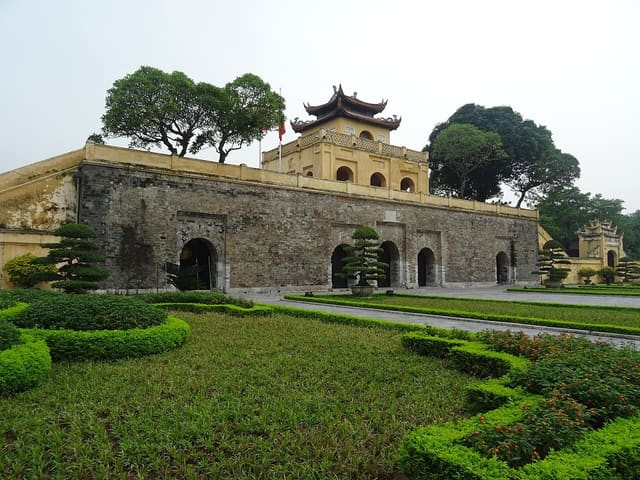
Imperial Citadel of Thăng Long
Remains of the royal citadel begun by the Lý dynasty in 1010. Its central sector became a UNESCO World Heritage Site in 2010.
This content is a draft that has not been reviewed yet.
Listen
Guide text
Short guide (~1 min)
This is the Imperial Citadel of Thăng Long. In 1010 Emperor Lý Thái Tổ began building the citadel, completing it early the next year. Many later dynasties ruled from here. The central sector was inscribed as a UNESCO World Heritage Site in 2010. Đoan Môn, the main gate in front, is a stone gate with five openings.
Full guide (~3 min)
This is the Imperial Citadel of Thăng Long. In 1010 Emperor Lý Thái Tổ, founder of the Lý dynasty, began building the citadel here, completing it early in 1011. Later dynasties continued to rule from this place.
On 31 July 2010 the central sector was inscribed as a UNESCO World Heritage Site.
Đoan Môn, the main gate, is a stone gate with five openings. The present structure dates from the Lê dynasty, with later Nguyễn additions. In 2002 archaeologists found an ancient Trần-dynasty carriageway beneath it.
Further in is the site of Kính Thiên Palace. The building is gone, but the stone steps in front still bear dragon carvings from the Lê dynasty.
At the 18 Hoàng Diệu site, major excavations in 2002–2004 uncovered remains from many periods layered on top of one another.
Within the grounds stands building D67, built in 1967. It was designed to look like an ordinary house and connects to an evacuation tunnel.
To the south is the Hanoi Flag Tower, 33.4 metres tall, built in 1812 under the Nguyễn dynasty. Take your time and feel a thousand years of the capital's history.
Practical info
- Opening hours
- Being verified
- Admission
- Being verified
- Suggested time
- 90 min
Etiquette
- Do not step inside the barriers around excavation sites.
- Dress code at temples: At pagodas and temples, cover your shoulders and knees. A light scarf is handy.
- Manners when visiting shrines: Remove your hat indoors and speak quietly. Ask before photographing people who are praying.