

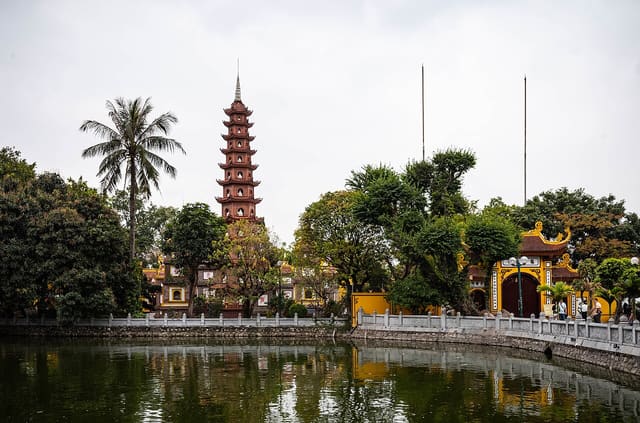
Trấn Quốc Pagoda
A Buddhist pagoda on a small island in West Lake. It is said to date from the 6th century, under Lý Nam Đế of the Early Lý dynasty, and is regarded as the oldest pagoda in Hanoi.
This content is a draft that has not been reviewed yet.
Listen
Photos
-
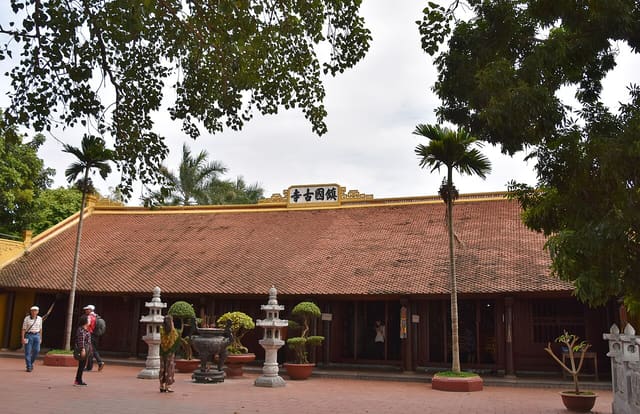
Grounds of Trấn Quốc Pagoda
Guide text
Short guide (~1 min)
This is Trấn Quốc Pagoda. It is said to have been founded in the 6th century under Lý Nam Đế of the Early Lý dynasty, and is regarded as the oldest pagoda in Hanoi. It first stood near the Red River and was moved to this island in West Lake in the 17th century. Today a narrow causeway leads to the island. The 11-tier stupa was built in 1998. The Bodhi tree in the grounds was a gift from the President of India.
Full guide (~3 min)
This is Trấn Quốc Pagoda. It stands on a small island in West Lake, linked to the shore by a narrow causeway.
The pagoda is said to have been founded in the 6th century under Lý Nam Đế of the Early Lý dynasty. It is regarded as the oldest pagoda in Hanoi, with a history of around 1,500 years. Its original name was Khai Quốc, and it first stood near the bank of the Red River.
In the early 17th century, as the river eroded its bank, the pagoda was moved to Kim Ngư islet in West Lake, where it stands today. The name Trấn Quốc dates from the late 17th century, under the Lê dynasty. In 1842 Emperor Thiệu Trị of the Nguyễn dynasty visited and renamed it Trấn Bắc, but people kept calling it Trấn Quốc, and that name is still used.
The grounds hold 14 stone stelae. The text of the 1639 stele was written by Nguyễn Xuân Chính, who had placed first in the royal examination. Most of the present buildings date from the early 19th century, after a major rebuilding from 1813 to 1815.
The red stupa is the first thing most visitors notice. Built in 1998, it is 15 metres high with 11 tiers, and each arched niche holds a statue of Amitābha Buddha.
Near the stupa grows a large Bodhi tree, taken from the tree at Bodh Gaya in India, where the Buddha is said to have attained enlightenment. It was given in 1959 to mark the visit of Indian President Rajendra Prasad.
In 1989 the pagoda was recognised as a national historical and cultural relic. If people are praying, please keep your voice down.
Practical info
- Opening hours
- Being verified
- Admission
- Being verified
- Suggested time
- 30 min
Etiquette
- Wear clothing that covers your shoulders and knees.
- Keep quiet near worshippers and ask before photographing them.
- Dress code at temples: At pagodas and temples, cover your shoulders and knees. A light scarf is handy.
- Manners when visiting shrines: Remove your hat indoors and speak quietly. Ask before photographing people who are praying.