

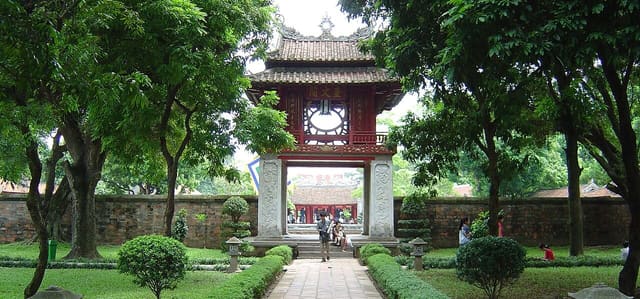
Temple of Literature
A Confucian temple built in 1070 that later housed the Imperial Academy, regarded as Vietnam's first national university. Stone stelae on turtles record the names of doctoral laureates.
This content is a draft that has not been reviewed yet.
Listen
Photos
-
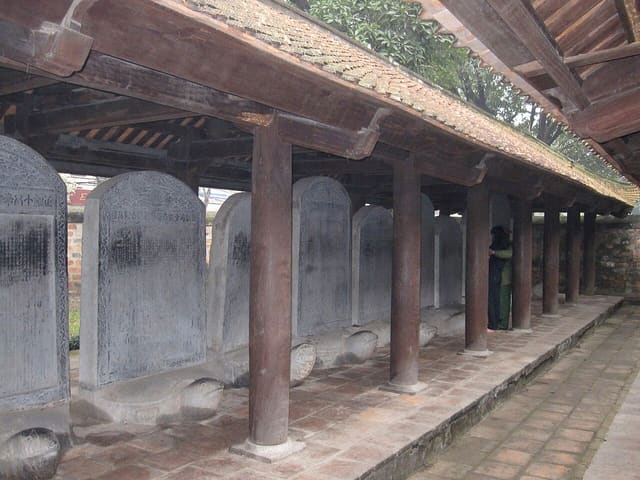
Doctoral stelae standing on stone turtles
Guide text
Short guide (~1 min)
This is the Temple of Literature, built in 1070 under Emperor Lý Thánh Tông to honor Confucius. In 1076 the Imperial Academy, regarded as Vietnam's first national university, was founded here. The grounds are divided into five courtyards. Look for the stone stelae standing on turtles: they record the names of doctoral laureates, and 82 of them remain today.
Full guide (~3 min)
This is the Temple of Literature, or Văn Miếu. It was built in 1070 under Emperor Lý Thánh Tông as a temple to Confucius. Six years later, in 1076, under Emperor Lý Nhân Tông, the Imperial Academy opened here. It is regarded as Vietnam's first national university and remained in use until 1779.
The grounds run north to south and are divided into five courtyards. Beyond the second courtyard stands Khuê Văn Các, a pavilion built in 1805 that is now a symbol of Hanoi.
The third courtyard holds stone stelae standing on the backs of turtles. Their erection began in 1484 under Emperor Lê Thánh Tông. They record 1,307 laureates of 82 royal examinations held between 1442 and 1779. The 82 surviving stelae were added to UNESCO's Memory of the World Register in 2011.
The fourth courtyard honors Confucius and four of his disciples, and the fifth also honors Chu Văn An, a rector of the Imperial Academy.
Students and their families still come here to pray before exams. The stelae are precious heritage, so please do not touch them.
Practical info
- Opening hours
- Being verified
- Admission
- Being verified
- Suggested time
- 60 min
Etiquette
- Wear clothing that covers your shoulders and knees.
- Do not touch the stelae or the turtle statues.
- Dress code at temples: At pagodas and temples, cover your shoulders and knees. A light scarf is handy.
- Manners when visiting shrines: Remove your hat indoors and speak quietly. Ask before photographing people who are praying.