

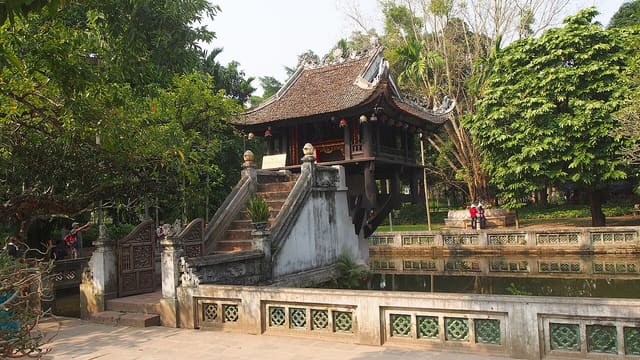
One Pillar Pagoda
A Buddhist temple built in 1049 by Emperor Lý Thái Tông. A small lotus-shaped shrine sits on a single stone pillar rising from a pond.
This content is a draft that has not been reviewed yet.
Listen
Guide text
Short guide (~1 min)
This is the One Pillar Pagoda, part of the Diên Hựu temple complex, built in 1049 by Emperor Lý Thái Tông. Legend says the childless emperor dreamed that Avalokiteśvara, seated on a lotus, handed him a baby boy. The small wooden shrine stands on a single stone pillar in a pond. It is shaped like a lotus flower, and inside, Avalokiteśvara is worshipped.
Full guide (~3 min)
This is the One Pillar Pagoda, or Chùa Một Cột. It is part of the Diên Hựu temple complex, and the shrine on the pillar is called Liên Hoa Đài, the Lotus Pedestal.
It was built in 1049 under Emperor Lý Thái Tông. According to court records, the childless emperor dreamed that Avalokiteśvara, seated on a lotus, handed him a baby boy. The monk Thiền Tuệ advised him to raise a pillar in a lotus pond and build a shrine on it, like the one in his dream.
The shrine is a small, square wooden building, about 3 metres on each side. The stone pillar beneath it stands about 4 metres above the ground and is made of two stone blocks stacked together. The whole structure is shaped like a lotus, a Buddhist symbol of purity. Inside, Avalokiteśvara is worshipped. The pond around it is called Linh Chiểu.
The temple has been repaired many times. In 1105 it was renovated, and a lotus pond and surrounding corridors were added. In 1109 a bell was cast, but it was too large to hang; it was melted down by Ming forces in 1426. Under the Nguyễn dynasty the temple was restored in 1840–1850 and again in 1922.
In 1954 the shrine was blown up. In 1955 it was rebuilt by the architect Nguyễn Bá Lăng, and what you see today dates from that reconstruction. In 1962 it was recognized as a national historical and cultural relic.
This is also a place of worship. Please dress modestly and keep quiet during your visit.
Practical info
- Opening hours
- Being verified
- Admission
- Being verified
- Suggested time
- 30 min
Etiquette
- Wear clothing that covers your shoulders and knees.
- Keep quiet and do not disturb people who are praying.
- Dress code at temples: At pagodas and temples, cover your shoulders and knees. A light scarf is handy.
- Manners when visiting shrines: Remove your hat indoors and speak quietly. Ask before photographing people who are praying.