

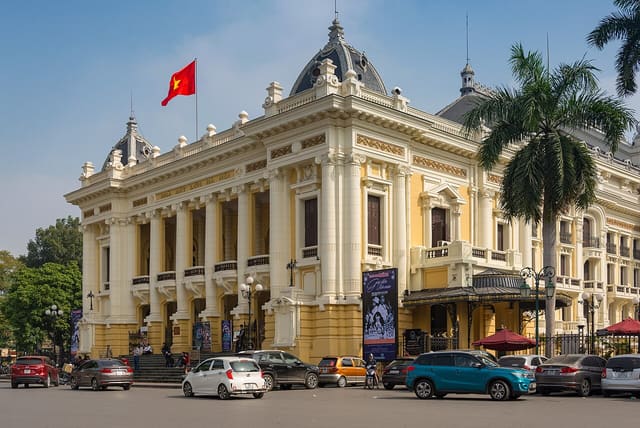
Hanoi Opera House
A theatre built between 1901 and 1911 under French rule, modeled on the Palais Garnier opera house in Paris.
This content is a draft that has not been reviewed yet.
Listen
Photos
-
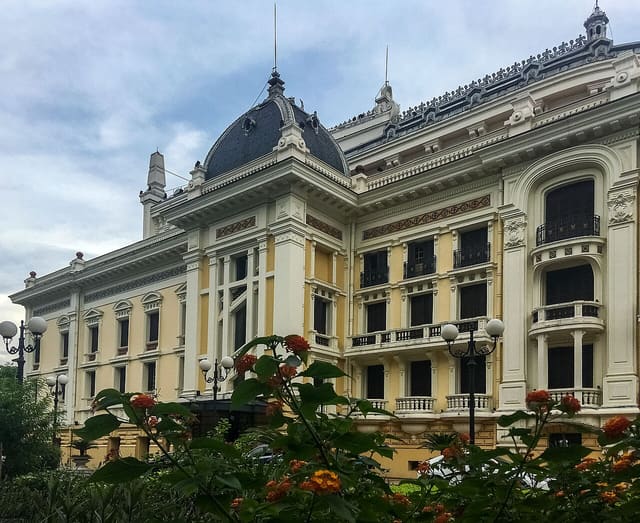
The architecture of the Hanoi Opera House
Guide text
Short guide (~1 min)
This is the Hanoi Opera House, known in Vietnamese as Nhà hát Lớn. Construction began in 1901 under French rule and it opened in 1911. It was modeled on the Palais Garnier in Paris. It is one of three opera houses the French built in Indochina. In 1946, the first session of Vietnam's First National Assembly was held here. A major restoration took place from 1995 to 1997.
Full guide (~3 min)
This is the Hanoi Opera House. In Vietnamese it is called Nhà hát Lớn, meaning "Grand Theatre"; in French it is the Opéra de Hanoï.
It was built under French rule as the Municipal Theatre. Construction began in June 1901 and it opened in December 1911, after about ten years of work. It cost two million francs. Its model was the Palais Garnier, the opera house in Paris. The main facade looks straight down Tràng Tiền Street. The building is neoclassical with eclectic elements, and it was designed by French architects. It is one of three opera houses the French built in Indochina; the other two are in Ho Chi Minh City and Haiphong.
The square in front is now called August Revolution Square. In August 1945, a large rally was held here. On 16 September 1945, Hồ Chí Minh launched the "Gold Week" fundraising campaign at the theatre.
On 2 March 1946, the first session of the First National Assembly of the Democratic Republic of Vietnam met in this theatre. The Assembly continued to meet here until 1963.
By the late 20th century the building had fallen into serious disrepair. Ahead of the Francophone Summit held in Hanoi in 1997, it underwent a major restoration from 1995 to 1997.
In 2011, the theatre and the square were recognized as a national historical and architectural monument. Stand by the front steps to take in the whole building.
Practical info
- Opening hours
- Being verified
- Admission
- Being verified
- Suggested time
- 30 min
Etiquette
- When attending a performance, dress neatly and stay quiet during the show.
- Dress code at temples: At pagodas and temples, cover your shoulders and knees. A light scarf is handy.
- Manners when visiting shrines: Remove your hat indoors and speak quietly. Ask before photographing people who are praying.